
How to Perform Hajj?
Bestur Turizm
Writer
Therefore, while setting out on this path, just as you do the necessary heart cleansing; If possible, wear a nice scent. (As in other times, it is forbidden for ladies to wear scents that will be felt by others outside their homes.)
* Take your sanitary precautions. Wear clothes that comply with the prohibition of ihram.
Men undress all the clothes they are wearing, and only cover themselves with two pieces of cover called "izar" and "rida".
Izar refers to the piece that is tied to the waist and covers the body below the waist. Rida is the piece that is worn on the shoulder and covers the top.
It is recommended that these two covers be white, new and clean. Also, it should be thick enough not to reveal the limbs.
They wear slippers on their feet. If they cannot find slippers, they make their shoes so that they do not cover their heels.
Women do not take off their dresses. For them, hijab is always the most suitable and appropriate one. However, women do not cover their faces with anything that touches their faces, leaving no space between them. They wear shoes, socks, and gloves.
When Entering Ihram:
After these preparations, at the miqat border or before:
* As the sunnah of Ihram – If it is not the time for ablution - perform two rakats of prayer.
* After the prayer, make the intention for "umrah". center;">اللَّهُمَّ إِنِّى أُرِيدُ الْعُمْـرَةَ لِوَجْهِكَ God bless you. That's right. style="text-align: center;">
"O Allah, I want to perform Umrah for your sake. Make it easy for me to perform it and accept my umrah. For the sake of Allah, I made the intention to perform Umrah and put on ihram." Bring “Telbiye”. لَبَّيْكَ. لَبَّيْكَ لاَ شَرِيكَ لَكَ لَبَّيْكَ. God bless you, God bless you لَكَ." style="text-align: center;">"O Allah! I am ready to run to your command and obey at any time. I have no partner with you. I accept your orders and invitations wholeheartedly and faithfully. Surely, praise and blessings belong to you. The property is yours. You have no partner."
From Ihram After
* Once you make the intention and say talbiya, you are considered to be in ihram. From this moment on, pay attention to the prohibitions of ihram.
* Perform talbiyah along the way, especially as you ascend to the hills, descend to the valleys, encounter a new group, stay and move, and go to a new region or city.
* Choose to bring talbiyah three times at a time. Do not forget to say takbir, tehlil and salawat to the sheriff.
When You Arrive in Mecca
* When you reach Mecca, get yourself in order again. Take bath or ablution.
* Head towards Beytullah with talbiyah, takbir and tahli.
* During these times, help your believing brothers more selflessly than ever before. Please advise the truth. Do not offend them.
* Even if the difficulties and fatigue of the journey are upon you, avoid being cranky and fighting with others.
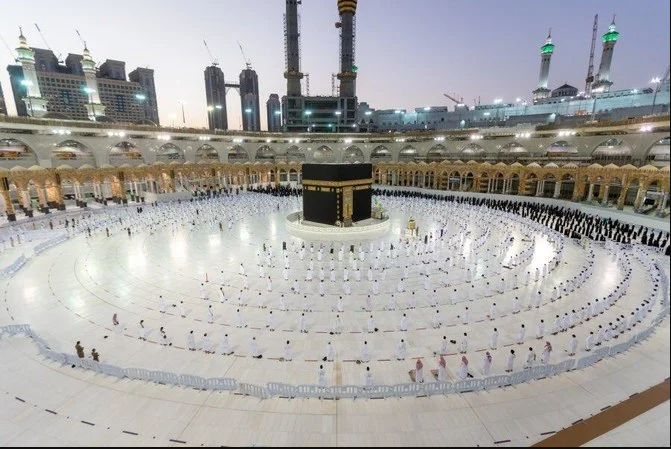
* Be prepared physically and spiritually for the first time you see Beytullah. Once you arrive, pray with sincere feelings. Thus, the right shoulder remains exposed. This is called “ıztıbâ”; It is sunnah of tawaf with a number behind it. And it continues throughout the tawaf. When you finish the tawaf, cover your shoulders. It is makruh to pray with one's shoulders open. Make the intention and start circumambulating the Hacerü'l-Esved.
İstîlam: It means touching the Hacerü'l-Esved. The remote sign also takes its place. It is done by raising both hands with the inner part facing Hacerü'l-Esved and saying "Bismillahi Allahu Akbar".
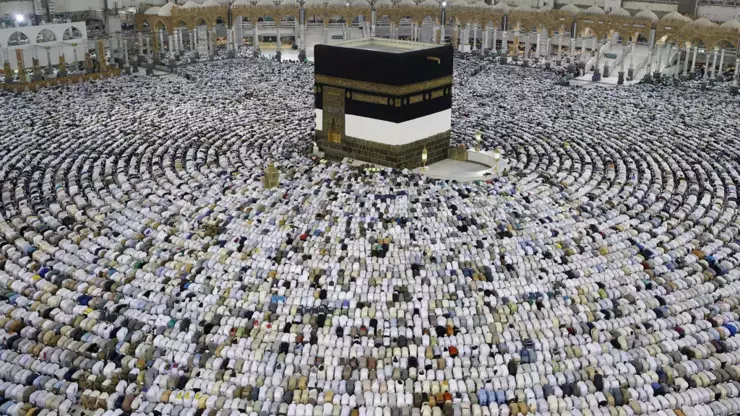
Tawaf takes 7 rounds. Each round begins in Hajar al-Esved and ends in Hacer al-Esved. It means walking in a light running position, shaking the shoulders and strutting. Ladies do not perform ramel.
* When you finish the tawaf, perform the two-rakat tawaf prayer. This prayer is important. If you are in a time of affliction, leave it for later and perform it at a perfect time.
* Then drink plenty of Zamzam and pour it over your body.
* While heading towards Safa, come to Hacerü'l-Esved and Leave by invading. It is from the Sunnah.
Say takbir, tahlil, praise, salawat.
* Arrive at Safa. The Sa'y you will perform is the "Sa'y of Umrah". Say sa'y with this intention.
* Perform "hervele" between two green poles.
Hervele: It is the name of the fast run. It is different from Remel, it is faster. However, one should not run with all their might in a way that would damage the dignity of the Muslim.
It is the sunnah of every shawt of Hervele sa'ın. Ladies don't do hervele.
Sa'y is 7 rounds. The walk starting from Safa and ending in Marwa is a shawt. Returning from Marwah to Safa is the second round. Thus, the ongoing sa'y starts from Safa and ends in Marwa.
In other words, the sa'y consists of 7 rounds, 4 going from Safa to Marwah and 3 returning from Marwah to Safa.
* After Sa'y, shave your hair and get out of ihram. Thus, your Umrah will be completed.
There are two types of haircut:
Folk: It means shaving the entire hair from the bottom. This is more effective.
Takkir: Cutting off a "common amount" (the length of the three knuckles of the finger) from one-third or one-fourth of the head. Shaving that harms the dignity of a Muslim, such as leaving bangs, is makruh.
Those whose hair length is less than the "unmüle" amount cannot make a tasir, the people have to do it. Ladies just make mistakes. It is considered tahrimi makruh to do it in public.
*From the moment you shave, all ihram prohibitions are lifted. Your Umrah is completed. In Mecca, you can wander around like a Meccan until you put on ihram again, perform voluntary tawaf, and spend your time worshiping and praying. Appreciating the moments you are in and doing them justice is a real blessing.
On the 7th day of Dhul-Hijjah, the sermon is read in the Haram Al-Sharif following the noon prayer.
Dhul-Hijjah. 8th Day: Terviye Day, today the convoys prepare to ascend to Arafat.
After completing the necessary cleaning and preparation for Ihram (men dressing in "izar" and "rida"), perform a two-rakat prayer.
Make intention for Hajj after the prayer. This intention is made as follows: God bless you. نَوَيْتُ الْحَجَّ وَ أَحْرَمْتُ بِهِ ِللهِ تَعـاَلىَ.
“O Allah, I want to perform the pilgrimage for your sake. Make it easy for me and accept my pilgrimage. For the sake of Allah, I have made the intention of performing the pilgrimage and put on the ihram.”
Pray the talbiyah after performing the prayer.
Talbiye :
لَبَّيْكَ اَللَّهُمَّ لَبَّيْكَ. لَبَّيْكَ لاَ شَرِيكَ لَكَ لَبَّيْكَ. God bless you, God bless you لَكَ." style="text-align: center;">"O Allah! I am ready to run to your majestic commands and obey at any time. There is no partner with you. I accept your commands and invitations wholeheartedly and faithfully. Surely, praise and blessings belong to you. The property is yours. You have no partner."
Intention and talbiyah When you bring it, you are in ihram again. From this moment on, pay attention to the prohibitions of ihram.
* The convoy - with the sunnah - heads towards Mina. Starting from the noon prayer of the day, he performs the afternoon, evening, isha and morning prayers of the Day of Arafa in Mina. If there is no legitimate reason to go directly to Arafat, head towards Mina.
* After sunrise, the convoys depart for Arafat. Arrive at Arafat before noon.
When the stampede, the congestion on the roads, and the worry of not being able to reach Arafat are added to the elderly and sickness of most of our pilgrims, most of the convoys now go to Arafat without stopping at Mina.
9th Day of Dhu al-Hijjah: Day of Arafa.
The time for the foundation in Arafat begins after the zawal prayer. It is evaluated with salawat, istighfar, dhikr, recitation of the Holy Quran, the best of dhikrs, and conversations infused with knowledge and wisdom, which raise awareness on the true path, encourage taqkr and takfir, and are filled with knowledge and wisdom.
Preparations are made for prayer. Noon and afternoon prayers are performed together at noon time. This is called "cem-i taktim" because it is performed at the time of the noon prayer, after the afternoon prayer is presented. This cem is sunnah.
The Form of Cem-i Takdim:
An adhan is recited for every two prayers.
If the time and situation are suitable, the first sunnah of the noon prayer is performed.
The iqamah is brought for the noon prayer.
The noon prayer is performed. (The imam reads the recitation secretly.)
The last sunnah of the noon prayer is not performed as the sunnah of the afternoon prayer. center;">
Asr prayer is performed. (The imam recites the recitation secretly)
Tashrik takbirs are recited at the end of each prayer. Please apply.
- Following the prayer, the foundation moment has started. Do not stay outside the borders of Arafat anymore, and do not go outside the borders unless the sun sets.
- Try to make the most of these minutes, which are among the most precious moments of life. Take precautions in advance for your physical needs.
- Use your time with the recitation of the Holy Quran, the best of dhikrs, asking for forgiveness and praying. Do not forget to pray for blessings for Islam, your other religious brothers, your friends, your relatives, your children, and future generations.
- Prepare your hearts to accept everything that is commanded by Islam and to reject everything that is contrary to Islam.
- Cleanse the leaks of ignorance within you, renew your determination to surrender to Allah with everything you have.
Our Prophet (pbuh) says: "There is no other day on which Allah frees His servants from hell more than the day of Arafat." (Bukhari)
* The foundation in Arafat is the first of the two pillars of the pilgrimage.
* Make the "foundation prayer" collectively at a suitable time.
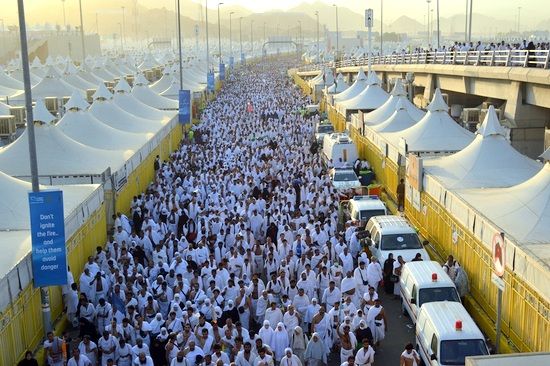
* Road preparations are made as soon as the sun sets. The pilgrim crowd begins to flow towards Muzdalifah. You too, go to Muzdalifah with your caravan at a convenient time.
* During the Hajj, be on good terms with your brothers and sisters around you, especially in difficult times. And help me. Be forgiving of the flaws towards you. You win the maturity race.
* Do not perform the evening prayer on the roads before reaching Muzdalifah. Even if you stay in a crowded place, wait until the time for the night prayer is in danger.
In Muzdalifah
* Perform the evening and night prayer together at the time of the night prayer.
This is called "cem-i postponement" because the evening prayer is postponed until the isha time. This cem is "obligatory".
How to perform Cem-i Tehir:
The adhan is recited for both prayers and the iqamah is recited.
First, the fard prayer of the evening prayer is performed. (The takbir of tashriq is recited afterwards.)
Sunnah cannot be performed in between. Adhan and iqamah are not returned.
He gets up and the obligatory night prayer is performed. (The takbir of tashriq is recited afterwards.)
The last sunnah of the night prayer can be performed.
Afterwards, the witr prayer is performed.
After this, rest if you have time. Collect stones for Jamrah.
It is sunnah to collect the 7 stones that will be thrown to Jamrah al-Aqaba on the first day from Muzdalifah. It is permissible to take the others from Muzdalifah or another suitable place.
However, do not take stones from the mosques. Do not obtain it by breaking a large stone. Do not pick up the stones thrown at the cemres. Do not collect stones from impure places. These are makruh.
The stones should be between the size of a chickpea and hazelnut.
* When the morning adhan is recited, perform your prayer without delay. Following the prayer, make the "foundation prayer".
This foundation in Muzdalifah is "obligatory".
* When the day dawns, move towards Mina. Say talbiyah, takbir and tehlil along the way.
In Mina
* Place your weights in your tents in Mina. Make preparations to make this your main place to spend the night on the days of Mina.
* Head towards stoning with your group. Do not approach stoning when the stampede is extreme. Especially women, the sick and the elderly need to be more cautious.
* Do not engage in grinding in large groups. Do not take bulky items with you. Take as much preliminary precautions as possible for bad possibilities.
* Come to Cemretü'l-Akabe, (Great Jamre). If possible, stand with Mina on your right and the Kaaba on your left while throwing stones at the cemre. If possible, 3/5 m apart. Approach it in such a way that it stays. See where your stones fall.
* Cut the talbiyah when you start throwing stones.
* Hold the stone you are going to throw between your thumb and index finger. By raising your arm and; لِلشَّيْطاَنِ رِضـاً لِلرَّحْمنِ.
Throw 7 stones by saying "Bismillahi Allahu Akbar! To break Satan's pride and arrogance, to rub his nose, to gain the consent of the Most Merciful."
It is enough for the stones to fall into the pool. style="text-align: center;">The time for these stones to be thrown into Cemretü'l-Akabe on the first day of the Eid begins with the dawn of dawn and continues for 24 hours until the dawn of the next day. It is between sunrise and noon / zawal time.
The time from zawal to sundown is the permissible time. There is no harm in throwing stones at this time.
There is no harm in healthy men stoning stones after sunset until the dawn of the faithful (at night). There is no harm in stoning at that time.
(Just as there is no harm in women throwing their stones at night, there are scholars who consider this more appropriate because it suits their state of dress and prevents them from getting into crowds.)
* After throwing your stone, sacrifice your "sacrifice of gratitude".
* Then exit ihram by shaving your hair with the expression "halk" or "taqsir". information has been given.
From the moment you shave, all ihram prohibitions have been lifted, except for husband-wife relations.
* After this, go to Haram-i Sharif and perform your obligatory tawaf.
The duties of the first day of Eid al-Adha in Mina are as follows, in the most correct order:
1 – Throwing stones at Cemre-i Aqaba
2 – Sacrifice of gratitude cut
3 – Shaving the hair
4 – Performing Farz Tawaf
The arrangement between the first three of these is Abu According to Hanife, it is obligatory and sunnah for the fard tawaf to follow this order.
It is best to perform the fard tawaf / visiting tawaf on the first day of the Eid. If the first day is not possible, the 2nd day is done, and if the second day is not possible, the 3rd day is done.
If it is delayed beyond the 3rd day without a religious excuse, this delay requires the punishment of sacrifice according to Hazrat Abu Hanife.
Menstruation is a religious excuse.
This circumambulation is one of the two pillars of Hajj. Unless a believer performs this tawaf, his hajj is not fulfilled. It can be done until the end of life. If the penalty falls due to the delay, it will be fulfilled.
* After performing the fard tawaf and performing the prayer, head towards Safa to perform the sa'i of the hajj. On your way to Safa, turn and greet Hacerü'l-Esved. This is from the sunnah.
* Do your numbers as explained before, starting from Safa. This sa'y you perform is the sa'y of the hajj. Do it with this intention.
It is permissible to advance the pilgrimage by intending to perform the pilgrimage, entering the ihram, and performing a supererogatory tawaf in front of it. However, its main place is after the fard tawaf and it is better to perform it in its original place during Hajj al-Tamattu.
* Return to Mina after the number. Make Mina your headquarters for the night. Because, according to the Hanafi sect, it is sunnah muakkadah to spend the night in Mina during the stoning nights. Maybe it is the "strongest" sunnah of Hajj. It is considered "obligatory" by other sects. It is also "recommended" to act by taking their opinions into consideration.
* Start casting the stones on the second and third day after noon time.
These days are the circumcision time; It is between sunset and sunset. It is permissible to throw stones until dawn.
In the provisions regarding stone throwing, the nights depend on the previous day.
* The stones of the second, third and fourth days are respectively;
7 stones to Cemretü'l-Vustâ (To Little Cemre),
7 stones to Cemretü'l-Vustâ (To Middle Cemre),
7 stones are thrown into Jamratu'l-Aqaba (Great Jamra). The second towards the direction of Mecca is the Middle Jamre and the last one is the Great Jamre.
* After throwing stones on the third day, if you are in a hurry and do not want to throw the stone on the 4th day, head towards Mecca before sunset on the 3rd day and go outside the borders of Mina.
Cemretü-l Aqaba is the end border of Mina borders in the direction of Mecca.
It was deemed "makruh" to leave Mina after evening (at night) and not to throw the stones of the 4th day. There is also a rumor that it requires the punishment of sacrifice.
If you are still in Mina after dawn on the fourth day, it is obligatory for you to throw stones on this day.
If you leave without throwing stones; The victim of punishment falls upon you unanimously.
4. The stones of the day can be thrown from dawn to sunset. The time after zawal is the time for circumcision. According to Abu Hanife, the time before zawal is makruh time.
4. When the sun sets, both the time for performing the stones and the time for qada are over.
In Mecca After Mina “tawaf-i sader” (farewell tawaf) is obligatory. Therefore, do your farewell tawaf before leaving.
* In the meantime, you can perform supererogatory tawafs, and after your duties in Mina are completed, if you have time, you can perform new umrahs. Its miqat is outside the boundaries of the harem. Going outside the border, you put on ihram there for Umrah. In the first of these, our Mother Aisha entered Ihram upon the order of the Messenger of Allah, and in the second one, the Prophet himself entered Ihram.
It is recommended to perform the farewell tawaf when leaving Beytullah for the last time.
Women who could not perform the farewell tawaf due to their disability can leave Mecca with their convoy. This is a religious apology. There will be no penalty imposed on them for not being able to perform the farewell circumambulation due to this excuse. The one who created us knows us best and has infinite mercy. / Source: Dr. M. Şerafeddin KALAY- Pilgrimage Guide
Bestur Turizm
Writer
As Bestur Turizm, we are with you in your pilgrimage and umrah journeys.
Our other articles arrow_forward